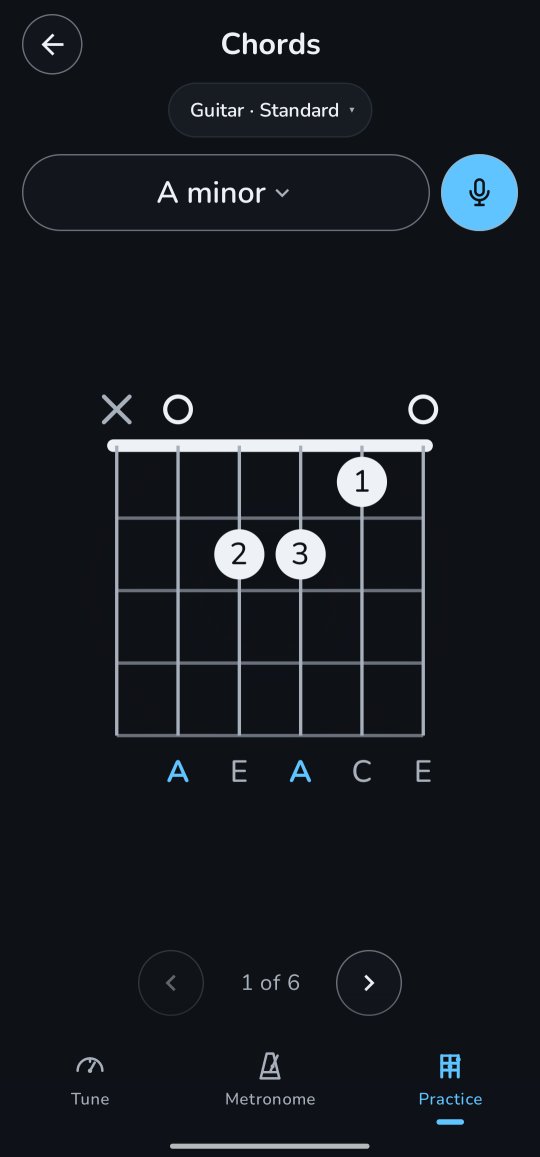
Chord name
Strum a chord and Twangle names it. Handy to find out what you just played, to check a chord you are learning, or to work out a song by ear. It lives in Practice → Chords, so you see the chord's chart as soon as it is named.
Name a chord
- In Practice, open Chords and tap the round microphone button beside the chord's name. It fills in while it listens.
- Strum a chord and let every string ring.
- After about a second it becomes the chord shown: its name, for example A minor, and its chart, for your instrument and tuning.
- Strum the next one, and it takes the place. Tap the button again to stop listening; leaving Chords stops it too.
Which chords it knows
Major and minor chords, the seventh, major seventh and minor seventh, sus2 and sus4, the power chord (E5), the 7♯9 and the minor and major ninth, each from any note. When the lowest note isn't the chord's own, it says so: C/E, C major, E in the bass.
When a strum isn't clearly one chord, Twangle names nothing. It never guesses. Strum all the strings of the chord, and mute the ones that don't belong to it.
The notes are written the way you set in Settings → Note names: letters with sharps or flats, German (H for B), or Do Re Mi.
Good to know
- It works on the guitar (6, 7 and 8 strings), the ukulele, the mandolin and the banjo. The 12-string's octave strings ring too close together, and bass and bowed instruments rarely play chords.
- One string plucked at a time names nothing; the chord shown stays. To check the open strings, use the tuner's Strum check.
- An instrument a little out of tune as a whole, or tuned to another reference pitch, is still named right; tune it anyway for the best results.
For the curious: how a chord is named
Unlike the strum check, here Twangle doesn't know which notes to expect: a chord can put any note on any string, leave strings out and double others. So it finds the notes first. A note sounds with its harmonics, at two, three, four times its pitch, and those land on other notes: the third harmonic of an E is a B, the fifth a G♯. Simply adding up all the sound per note would turn an E power chord into E major.
So Twangle takes the strongest note, removes its harmonics from the sound, and looks again for the next, until only faint sound is left (iterative estimation and cancellation, after Anssi Klapuri, 2003 and 2006). The notes it found are matched against the chords it knows. Twangle reads the chord ten times a second, and a name shows once it wins four of the last six readings, so one stray reading never changes it.